

Dreams about bees often symbolize teamwork and collective achievement, reflecting nature’s most efficient organizational model. A single hive operates as a superorganism where 60,000 individuals perform specialized roles—from the queen laying 1,500 eggs daily to workers progressing through age-based tasks like nursing, guarding, and foraging. This division of labor, combined with communication through waggle dances and democratic decision-making, enables colonies to pollinate crops worth $6.4 billion annually while producing honey. The principles underlying this natural collaboration reveal understandings about productivity that extend well beyond the hive.
The Queen’s Role in Hive Hierarchy and Egg Production
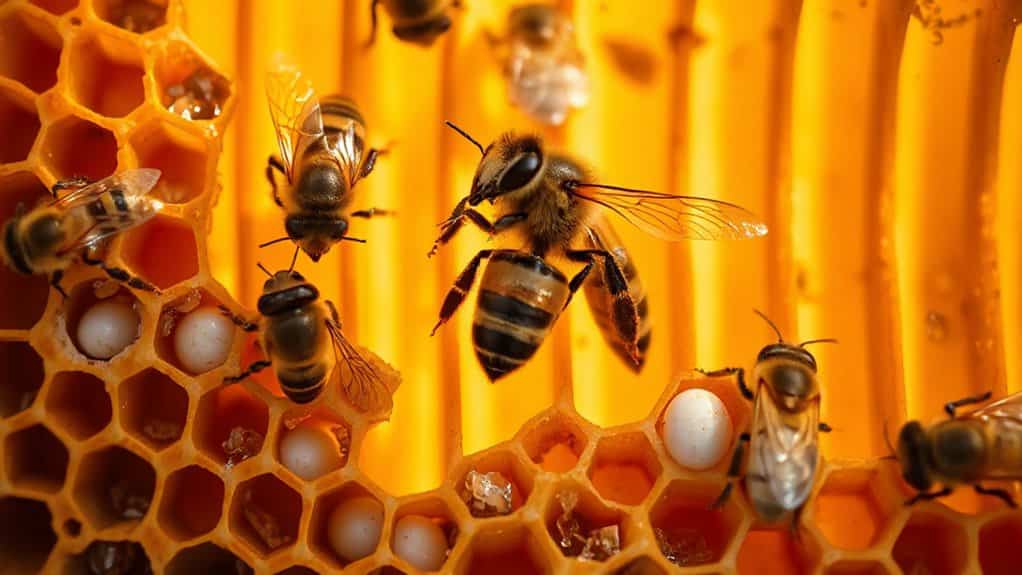
When you dream about bees, you’re often encountering symbols of complex social organization, and at the heart of this structure sits the queen bee.
She’s positioned at the top of the hive hierarchy, overseeing all colony activities as the single reproductive female. Just as penguins embody cooperative parenting and communal harmony in dreams, the queen bee’s central role can mirror how you manage responsibility and connection within your own social world.
Her extraordinary capacity to lay up to 1,500 eggs daily during peak season guarantees the colony’s growth and continuity, making her essential to the hive’s survival.
The queen typically lives 1–2 years, during which she’s constantly attended by worker bees who feed, water, clean, and groom her throughout the hive.
Worker Bees and Their Specialized Responsibilities
Worker bees embody the essence of specialized labor in your dreams, representing a sophisticated division of responsibilities that evolves throughout their brief lifespans. In dream symbolism, their coordinated effort can mirror the importance of emotional support networks working together toward a shared goal in your waking life.
They’ll progress from housekeeping duties—cleaning cells and maintaining hygiene—to nursing brood with up to 1,300 daily larva checks, then serving as queen attendants, guards, and ventilators, before finally becoming foragers collecting nectar and pollen within a five-mile radius.
These foragers communicate their discoveries through the waggle dance, directing colony members to productive food sources with remarkable precision.
Drones and Genetic Diversity Through Cross-Colony Mating
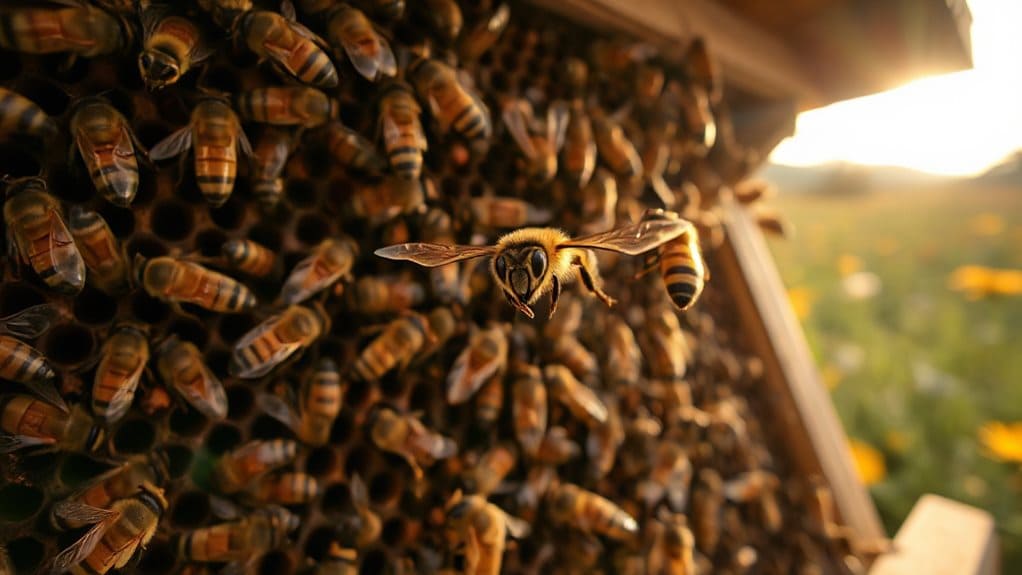
Unlike worker bees that dedicate themselves to colony maintenance, drones exist for a single biological imperative: to mate with virgin queens from other colonies and perish immediately afterward. Queens mate with 15-40 drones during nuptial flights at congregation areas hosting up to 20,000 males from different colonies. This competitive polyandry creates genetic diversity within hives, as each queen stores sperm from multiple fathers, producing subfamilies with distinct traits that enhance disease resistance and colony performance. Just as bear dreams in Native American traditions highlight collective wisdom and interconnected roles in nature, drone mating behavior underscores how individual sacrifice supports the resilience and continuity of the larger hive community.
Clear Role Definition Reduces Confusion and Increases Efficiency
When you observe a bee colony’s division of labor, you’re witnessing an organizational model where specialized tasks directly translate to measurable productivity gains. Worker bees progress through distinct age-based roles—from cleaning cells to foraging—which eliminates confusion about responsibilities and prevents multiple bees from attempting identical tasks. This clear role definition means the colony wastes minimal energy on coordination or redundant efforts, allowing resources to focus entirely on survival and growth. Just as trees rely on specialized structures like the cambium layer to coordinate growth and stability, clearly defined roles in a team ensure that energy is channeled efficiently toward long-term success.
Specialized Tasks Boost Productivity
Just as bees instinctively know whether they’re foragers, nurses, or builders, employees with clearly defined roles understand exactly what’s expected of them—and the results speak for themselves.
You’ll see 83% higher productivity when roles are crystal clear. This happens because specialization eliminates duplicated efforts, prevents tasks from falling through cracks, and lets you focus entirely on your specific responsibilities without confusion over who owns what.
Age-Based Role Transitions
While worker bees pass through predetermined life stages—from cell cleaning to nursing to foraging—your career path follows a surprisingly similar age-based progression, though with considerably more variation.
You’ll likely switch jobs every three years during ages 25-34, establishing foundational experience.
Between 35-44, shifts slow to five-year intervals as you pursue leadership roles.
After 45, you’ll typically change positions every seven to ten years, prioritizing stability over exploration.
Reduced Overlap Saves Energy
Like a hive where each bee knows exactly which cells to clean and which larvae to feed, organizations function most efficiently when every employee understands their specific responsibilities without overlap.
When you eliminate duplicate work and ambiguous task ownership, you’ll redirect energy from steering through confusion toward productive output. Explicit role definitions prevent wasted effort, reduce accountability conflicts, and allow team members to focus on high-value activities rather than constantly clarifying who does what.
The Waggle Dance: Nature’s Communication System
When you observe a honey bee’s waggle dance, you’re witnessing one of nature’s most sophisticated route-finding systems, where the angle and duration of each movement encode precise GPS coordinates to food sources.
The dance’s figure-eight pattern isn’t random—it’s a structured language where the waggle run’s direction relative to vertical indicates the sun’s bearing, while its length translates directly to distance in the field.
What makes this system notable is how follower bees interpret these signals through antennal contact and vibration detection, then compare multiple dances to reach a collective decision about which resource deserves the colony’s attention.
Much like how dreams of drinking water in spiritual cleansing symbolize renewal and clarity, the waggle dance functions as a unifying signal that helps the entire colony align around life-sustaining resources.
Decoding the Waggle Pattern
Deep within the darkness of the hive, honeybees perform one of nature’s most sophisticated communication systems through their waggle dance.
You’ll observe their figure-eight pattern encoding precise directional information, where vertical movements indicate the sun’s angle and run duration signals distance to food sources.
They communicate through multiple sensory channels—tactile vibrations, electric fields, sound pulses, and transferred scents—allowing followers to decode resource locations without visual cues.
Collective Decision Through Dance
As forager bees return from uncovering promising food sources, they don’t simply share their findings—they compete for their colony’s attention through simultaneous waggle dances that create what researchers call a “democratic debate” on the honeycomb floor.
Observing bees compare multiple performances, evaluating distance, direction, and resource quality. This collective assessment leads to hive consensus, focusing foraging efforts on the most beneficial locations and optimizing colony efficiency through shared information.
Democratic Decision-Making in Swarm Site Selection
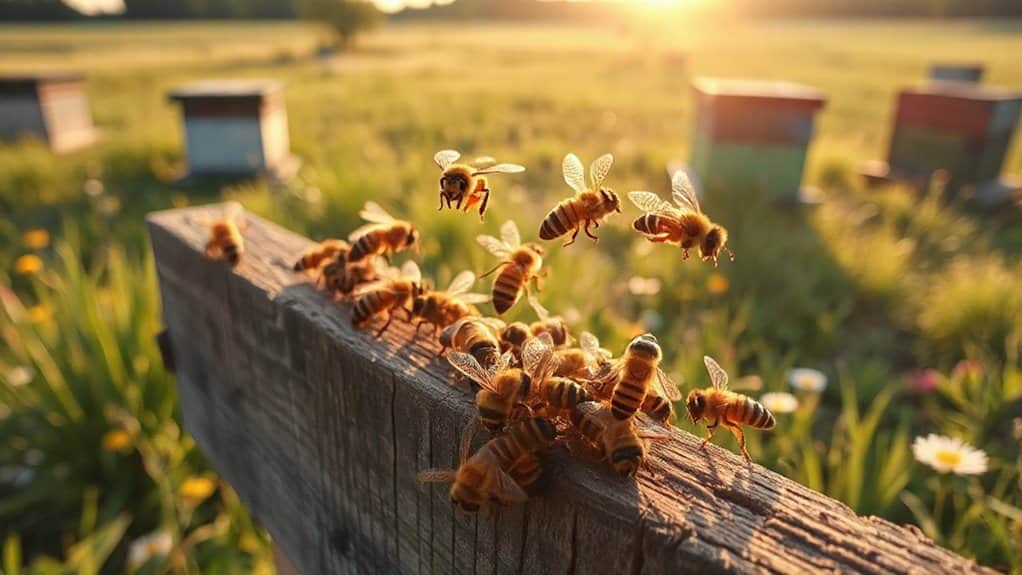
Honeybee swarms demonstrate one of nature’s most sophisticated examples of distributed democracy, where hundreds of scout bees collaborate to select their colony’s next home through a process that shares striking parallels with human decision-making systems.
Several hundred autonomous scouts from swarms of up to 10,000 bees evaluate dozens of potential sites, with no single bee dominating the process.
This broad participation guarantees knowledge diversity and prevents hasty choices.
Temporal Polyethism: Age-Based Task Specialization
Within a honeybee colony, workers don’t simply perform random tasks throughout their lives—they follow a remarkably predictable career path based on their age.
Newly emerged bees start with cell cleaning during their first five days. They then progress to brood care and nest maintenance from days two through eleven, followed by food processing duties until day twenty, when most shift to foraging outside the hive.
How Division of Labor Creates a Superorganism
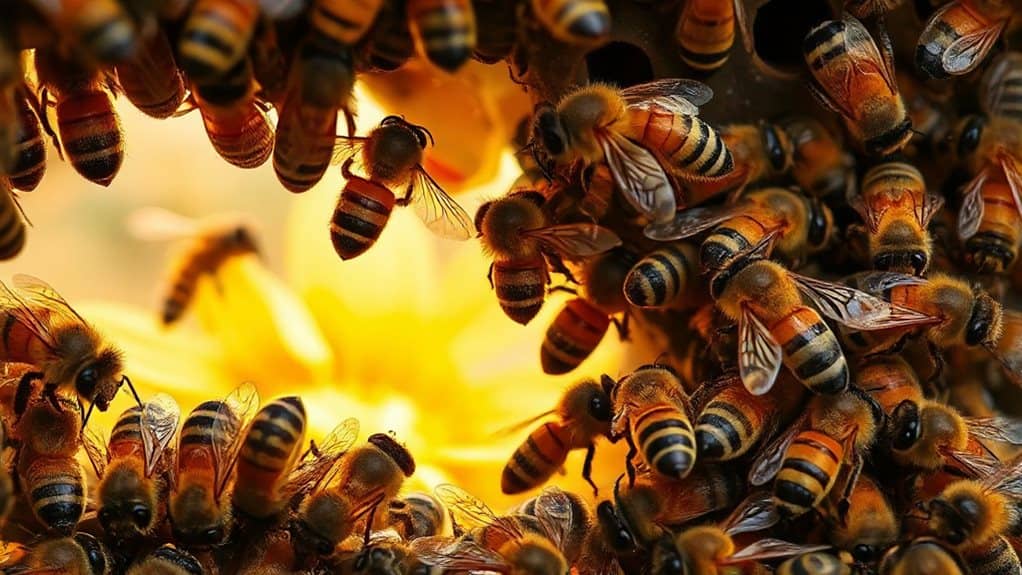
The age-based progression that moves bees through cleaning, nursing, and foraging roles creates something far more sophisticated than a collection of individual insects working side by side.
Through self-organized task allocation and reproductive division of labor, the colony functions as a superorganism—a single biological entity that reproduces through swarming, responds collectively to environmental threats, and optimizes resource accumulation through specialized physiological adaptations across thousands of workers.
Pollination, Honey Production, and Colony Success
Moving beyond their internal social structure, honey bees generate their most significant ecological and economic impact through pollination—a service that fundamentally connects colony survival to agricultural productivity and ecosystem health.
You’ll find that 75% of major crops depend on pollinators, with honey bees alone contributing $6.4 billion annually to U.S. agriculture while pollinating over 130 fruit and vegetable varieties essential for human diets.
Wrapping Up
You’ve seen how bees convert individual effort into collective success through structured hierarchy, specialized roles, and sophisticated communication. Their division of labor creates efficiency that’d be impossible for solitary insects to achieve. When you apply similar principles—clear responsibilities, effective information sharing, and collaborative decision-making—you’ll uncover that teamwork isn’t just nature’s strategy, it’s your pathway to achieving goals that seem overwhelming when faced alone.

Seraphina Lumina is a dream interpretation and symbolism researcher with a passion for exploring the connections between dreams, emotions, relationships, spirituality, and personal growth. She draws on traditional dream symbolism, psychological perspectives, and spiritual traditions to help readers make sense of their night-time experiences and the themes that may appear in them.