
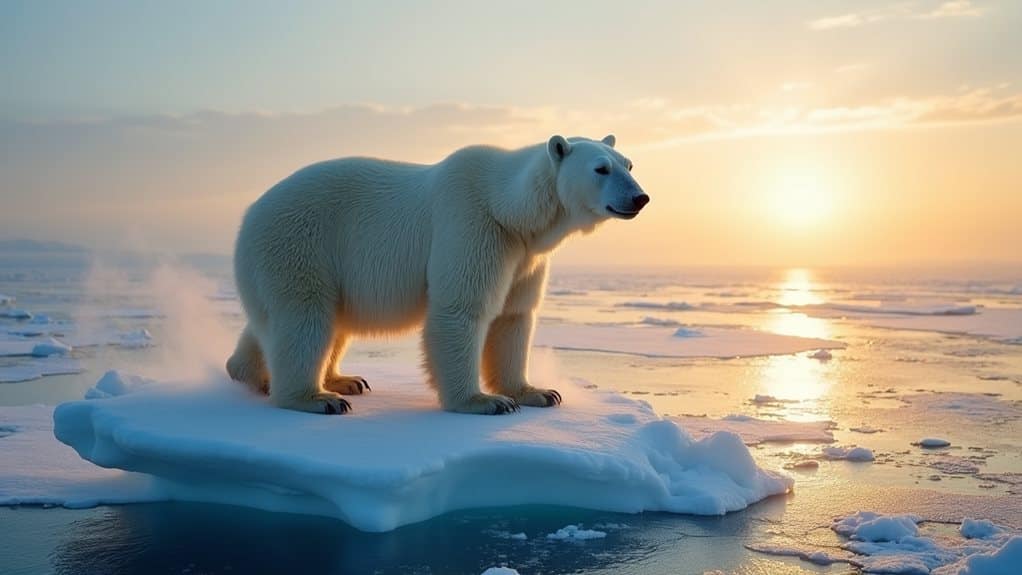
When you dream of a polar bear, you’re confronting a symbol that fuses raw physical power—males reaching 800 kg and standing over three meters—with extreme solitude necessary for survival in the resource-scarce Arctic. These apex predators hunt seals alone across thousands of square kilometers, relying on patience, tactical precision, and energy-rich blubber to endure months of scarcity. Their existence balances dominance with vulnerability, as isolation minimizes competition but amplifies climate threats. The following sections examine how these contradictions shape their symbolic resonance.
The Unmatched Physical Dominance of Arctic Giants

Polar bears dominate the Arctic terrain through sheer physical magnitude, standing as the largest land carnivores on Earth.
Adult males typically weigh 300–800 kg, though some exceed 1,000 kg, and they measure up to 3 meters in length. When standing upright, they can surpass 3 meters tall.
Their massive paws, reaching 30 cm in diameter, distribute weight effectively across fragile ice surfaces.
These bears exhibit pronounced sexual dimorphism, with males notably larger than females and possessing proportionally larger heads.
Many aspects of their biology can reflect broader themes of solitude and territory in nature, often likened to the symbolism of a large house in dream analysis.
Survival Through Strategic Energy Management
Beyond their imposing physical presence, Arctic survival hinges on a polar bear’s ability to strategically manage energy reserves in one of Earth’s most unforgiving environments.
You’ll find these bears entering energy-saving modes during food scarcity, slowing their metabolism rather than truly hibernating.
They consume calorie-dense seal blubber when available, building fat stores that fuel them through lean periods.
Their metabolic rates vary tenfold between seasons, demonstrating extraordinary physiological flexibility.
Females excavate maternity dens where they remain sheltered for months, conserving both energy and warmth during the demanding period of giving birth and nursing young.
Post-rejection dreams can mirror this need for energy management by highlighting how emotional resources are conserved and reallocated during stressful times.
Hypercarnivorous Hunters of the Frozen Seas

Atop the frozen Arctic seascape, these apex predators have refined seal hunting into an art form that demands extraordinary patience and tactical precision.
You’ll find them waiting motionless beside breathing holes for hours, stalking seals on ice floes, or launching surprise attacks from underwater.
Their hypercarnivorous diet centers on fat-rich ringed seals, though they’ll opportunistically consume marine mammals, seabirds, and carrion when primary prey becomes scarce.
Their solitary nature often leads to periods of profound isolation and power that shape their behavior and reproductive strategies.
Solitary Lives in a Sparse White Wilderness
Unlike most bear species that gather in productive feeding areas or maintain overlapping territories, the polar bear has evolved as an obligate solitary hunter across one of Earth’s most hostile and resource-poor environments.
You’ll find these apex predators roaming home ranges spanning thousands of square kilometers, where seals are scattered across ever-shifting sea ice.
This isolation isn’t antisocial—it’s survival strategy, minimizing competition where food remains desperately scarce.
Their solitary lifestyle also highlights the importance of recognizing individual resilience and adaptability when facing scarce resources and extreme conditions.
Remarkable Adaptability in a Changing Arctic
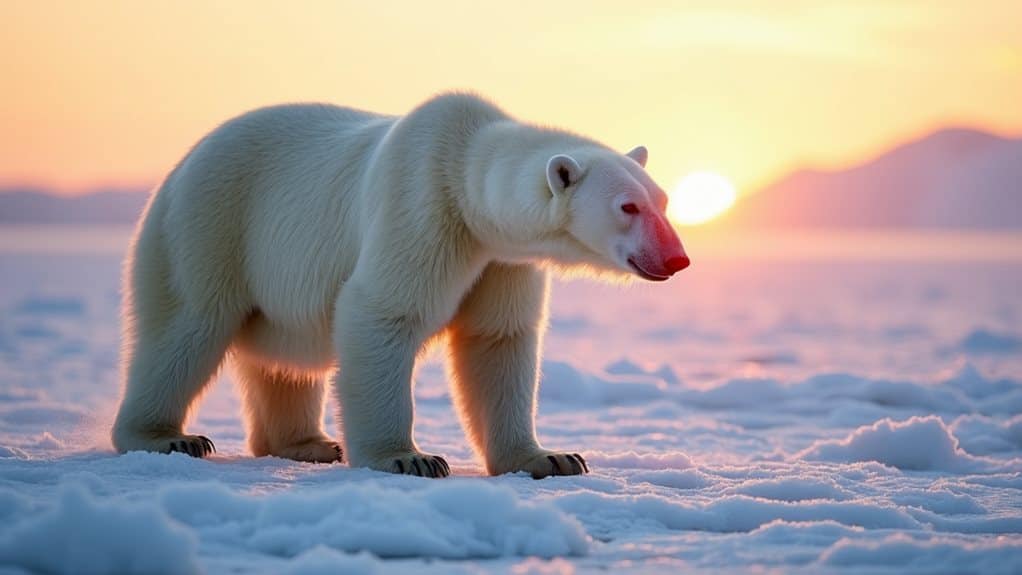
You’ll notice that polar bears don’t all respond to Arctic changes in the same way, as individual bears develop distinct survival strategies based on their experiences and circumstances.
These behavioral differences often stem from what cubs learn directly from their mothers during the critical two-year period they spend together, creating a transmission of knowledge that shapes hunting techniques and habitat preferences.
This variation in adaptive strategies explains why some bears successfully exploit glacier ice or land-based food sources while others in the same region struggle to find adequate nutrition.
Individual Variation in Strategies
As Arctic sea ice continues its dramatic decline, polar bears across different regions aren’t responding uniformly—some populations have developed extraordinary strategies that deviate from centuries-old patterns.
You’ll find bears in southeast Greenland using freshwater glacier ice as hunting platforms, while others swim hundreds of kilometers between fragmenting floes.
This behavioral plasticity reveals significant individual variation, though genetic and environmental factors determine which bears can successfully adapt versus those facing physiological limits in increasingly ice-free environments.
Learning Through Maternal Transmission
Within the protective walls of snow-packed maternity dens, polar bear mothers begin one of nature’s most critical educational processes—teaching cubs survival skills that will determine whether they can find their way through an Arctic reshaped by climate change.
This knowledge transfer extends roughly 2.5 years, during which cubs learn hunting techniques, den selection criteria, and behavioral adaptations essential for negotiating increasingly fragmented sea ice and prolonged terrestrial fasting periods.
Natural Isolation as Defense and Vulnerability
You’ve likely imagined the Arctic as an impenetrable fortress, where vast distances and extreme conditions naturally protect polar bears from threats.
This geographic isolation has historically worked in their favor, allowing solitary individuals to roam enormous territories without competition or conflict.
However, climate change is now converting this once-defensive barrier into a vulnerability, as melting sea ice fragments their habitat and traps subpopulations in shrinking, disconnected ranges.
Arctic Landscape as Barrier
Across the vast Arctic, the polar bear’s domain is defined not just by ice and cold, but by a network of natural barriers that simultaneously protect and constrain.
Barrier islands offer sanctuary for maternal dens, while sea ice creates ever-shifting shields for hunting across continental shelves.
Terrestrial denning zones within 32 kilometers of Alaska’s coast provide isolated nurseries, yet these same barriers limit genetic exchange and concentrate populations as ice retreats.
Climate Change Erodes Protection
As Arctic sea ice retreats at an unparalleled rate, the very isolation that once shielded polar bears from threats now collapses into vulnerability. You’ll find these apex predators spending two months longer on land than they did decades ago, exposing them to starvation, human conflicts, and industrial disturbances.
Fragmented ice platforms force energy-draining swims while denning sites disappear, leaving mothers and cubs defenseless against predators and harsh conditions.
The Mother-Cub Bond and Social Learning
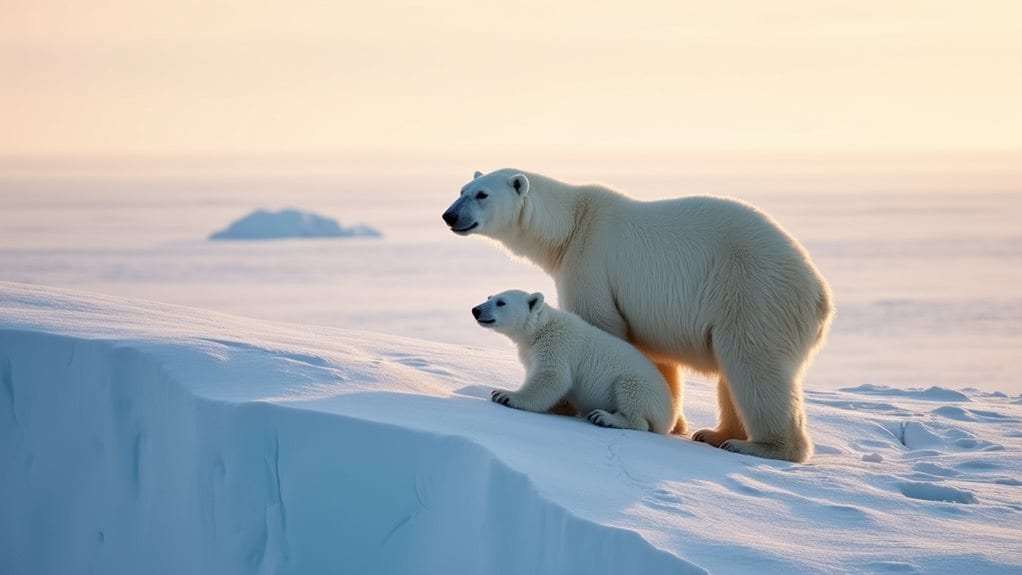
Survival in the Arctic begins with one of nature’s most demanding relationships: the bond between a polar bear mother and her cubs. Born blind and helpless in winter dens, cubs depend entirely on their mother’s fatty milk and body heat.
For two to three years, she teaches them essential hunting techniques, ice piloting, and predator avoidance through direct observation and mimicry, building their independence gradually.
Behavioral Flexibility Under Environmental Pressure
The Arctic environment that shapes mother-cub learning also demands constant behavioral adaptation from adult bears throughout their lives.
You’ll find polar bears adjusting home ranges and movement patterns as ice melts, though these shifts don’t compensate for lost hunting grounds.
Their foraging flexibility remains limited—terrestrial foods can’t replace energy-rich seals, resulting in declining body condition despite opportunistic feeding attempts.
Wrapping Up
You’ve seen how polar bears embody both supreme power and deep isolation in their Arctic domain. Their physical dominance and hunting prowess don’t shield them from vulnerability—instead, their solitary nature and specialized adaptations make them increasingly susceptible to environmental shifts. Understanding this paradox reveals why these apex predators, despite their strength, face mounting challenges. Their story illustrates how isolation that once protected them now threatens their survival in our rapidly changing world.