

A blank or distorted glass reflection in a dream signals a dissociative split, meaning you’re feeling disconnected from your core identity, often because of stress, burnout, or unresolved inner conflict. Jungian theory sees the empty mirror as an unintegrated Self, urging you to examine shadow aspects that have been suppressed. This symbolism can also point to fragmented autobiographical memory and a sense of being a “ghost” in your own life. Recognizing these cues can help you ground yourself and consider professional guidance if depersonalisation persists, and the next sections will explain how to move forward.
What a Blank Mirror Means in Your Dream

A blank mirror in a dream usually signals a deep disconnect from your sense of self, suggesting that you’re feeling emotionally numb or like a ghost in your own life. This kind of dream often reflects your subconscious using mirror symbolism to highlight unresolved emotions and inner conflicts that need your attention.
It reflects a loss of self‑awareness, where burnout, toxic relationships, or a soul‑crushing job erode your identity.
Jung sees the blank surface as an unintegrated Self, urging you to probe shadow aspects and reconnect with authentic values.
Identity transition can also surface when life changes force you to question who you truly are.
Dissociation in Mirror‑Glass Dreams
The unreal perception of the mirror—where the reflection feels foreign—points to a dissociation that detaches you from usual emotional resonance.
This combination often signals that your psyche is isolating feelings while trying to integrate a disjointed sense of identity.
In some cases, this dreamlike detachment parallels the blurred boundary between sleep and wakefulness seen in false awakenings, where consciousness struggles to distinguish internal imagery from external reality.
Fragmented Self‑Image
When sleep fragments autobiographical memory, isolated pieces of your self‑image can surface in a glass or mirror without the surrounding background that normally binds them together.
You may notice a disjointed face, missing emotions, or a detached posture, reflecting how REM disruptions and trauma compartmentalize identity.
This fragmented self‑image mirrors dissociative amnesia, where each part functions independently, limiting coherent self‑recognition.
Unreal Mirror Perception
Because the glass reflects a world that feels both familiar and alien, many people experience an “unreal mirror” sensation in dissociative dreams, where the reflected self appears detached, distorted, or duplicated.
You may notice split‑mirror effects dividing your face vertically, creating double‑identity visions that echo research on AN patients and dyadic gazing.
These hallucinations often reduce explicit agency, while implicit control persists, highlighting how dissociation reshapes self‑perception without fully disconnecting body awareness.
Detached Emotional Resonance
The “unreal mirror” sensation that hall in dissociative dreams often gives way to a subtler effect: detached emotional resonance.
You notice feelings floating apart from your reflected self, as if the glass separates sentiment from identity.
This detachment mirrors shattered‑glass symbolism, where fragmented shards represent coping mechanisms that mute agency.
Recognizing this pattern can help you interpret inner conflict without over‑identifying with the emotional echo.
Jungian Shadow Work for the Unrecognised Self
If you notice that your dream reflection is unrecognizable, it signals a split between your conscious ego and the shadow parts you’ve kept hidden. Jungian shadow work invites you to dialogue with those disowned fragments through active imagination, meditation, or artistic expression. In Jungian terms, such a dream can function as an inner compass, much like other shadow-related dreams, pointing you toward neglected aspects of the self that are seeking integration.
Integrating a Fragmented Identity After Mirror‑Glass Dreams
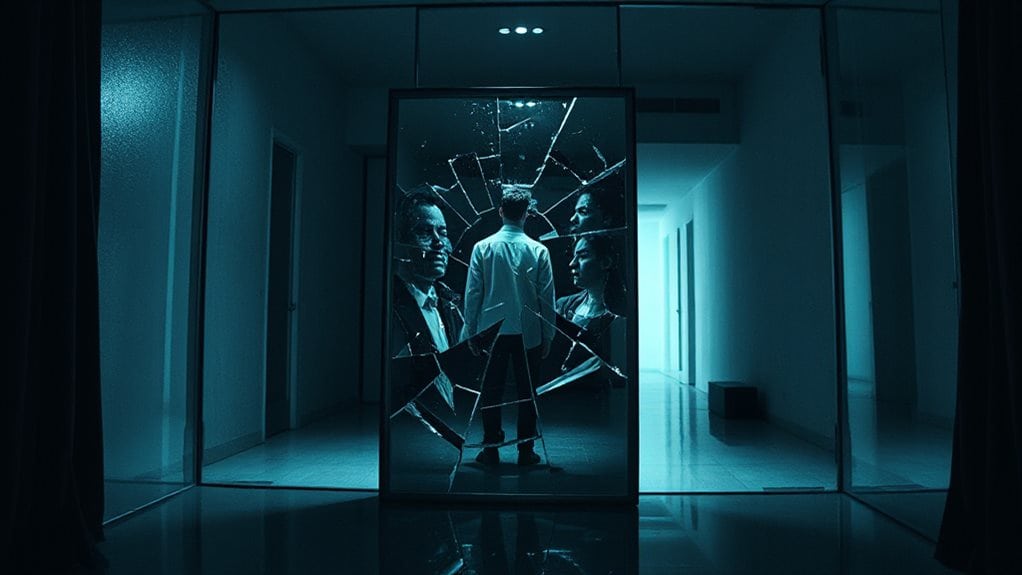
When a mirror‑glass dream leaves you seeing an unrecognizable face, it signals that your sense of self is split into separate, uncommunicating fragments.
You begin integrating by processing traumatic material with EMDR or IFS, reducing dissociative barriers and allowing shared memories to flow.
Consistent grounding, internal communication, and somatic work support a cohesive self‑view, moving toward the 27‑month integration benchmark.
In this process, dream work that explores how distorted reflections express hidden emotions can deepen self‑understanding and support the integration of fragmented identity.
How to Ground Yourself When Your Reflection Feels Strange
You can start by tuning into your breath, inhaling for four counts and exhaling for six, which steadies the nervous system and creates a clear anchor for the mind.
Then, pick a sensory detail—like the temperature of the air on your skin or the texture of the floor under your feet—and focus on it until the strange reflection loses its grip on your attention.
Finally, combine these steps with a brief, repeatable ritual such as a quick body scan or a grounding phrase, so you have an immediate, low‑effort tool whenever dissociation spikes. In the days that follow, you can also journal about whether the dream felt more like a literal replay of your day or a symbolic message, helping you track patterns in your emotional landscape.
Grounding Through Breath Awareness
Clarity emerges when you shift attention from the unsettling image in the mirror to the rhythm of your breath. Slow, deep belly breathing—inhale for four seconds, exhale for six—activates the parasympathetic system, lowering fight‑or‑flight arousal.
Pair each inhale with a calming word like “safe,” and notice chest expansion, providing a concrete anchor.
Repeating this pattern builds muscle memory, so during dissociative spikes you can quickly re‑ground without effort.
Anchor Body With Sensory Details
In the moment your reflection feels unfamiliar, anchoring your body with concrete sensory details can interrupt the dissociative loop and restore a sense of present‑moment reality.
Name five visible objects, then four sounds, three textures, two smells, and one taste.
Feel your feet’s weight, press hands together, scan sensations from head to toe, and notice each cue deliberately.
Create Immediate Safe Rituals
When the glass image feels foreign, immediate safe rituals combine sensory input, mental focus, and controlled breathing to interrupt the dissociative loop and re‑anchor you in the present.
Hold an ice cube, trace it along your arms, then splash cold water on your face.
Count backward by sevens while practicing 4‑7‑8 breathing.
Name three nearby objects, then press your feet firmly into the ground, noticing pressure and stability.
What Life Events Trigger Mirror‑Glass Dreams?
If you’ve recently faced a major life shift—such as losing a job, moving to a new city, or ending a long‑term relationship—you may notice dreams in which your reflection looks unfamiliar or even unrecognizable.
Trauma, relocation, relationship loss, adolescent hormonal changes, sudden role changes, cultural identity shifts, social isolation, and certain medical or neurological conditions all disrupt mirror‑neuron activity, prompting unrecognizable‑reflection dreams within weeks of the event.
When Mirror‑Glass Dream‑Related Depersonalisation Needs Professional Help

After exploring how life changes can trigger mirror‑glass dreams, it’s important to recognize when the resulting depersonalisation moves beyond occasional discomfort.
If detachment persists weeks, distorts reality, or disrupts work, relationships, and daily tasks, seek professional evaluation.
A clinician will rule out medical causes, assess psychological factors, and may recommend CBT, psychodynamic therapy, or medication.
Early specialist help prevents worsening and supports recovery.
Quick Self‑Check: Measuring Your Dissociation Level
Because you can quickly gauge how often dissociative experiences occur, the DES‑II self‑check offers a practical first step before seeking professional help.
You rate 28 items from 0% to 100% based on everyday experiences, then sum the percentages.
Scores 30 or higher suggest heightened dissociation and warrant clinical follow‑up, while lower scores indicate typical levels.
This brief, adult‑focused tool screens amnesia, depersonalization, absorption, and identity confusion.
And Finally
You’ve learned that a blank or distorted mirror in a dream signals a split between your conscious self and a fragmented identity. The symbolism points to dissociation, unresolved shadow aspects, and possible triggers like stress or trauma. Grounding techniques and self‑checks can help you gauge the intensity of the experience, while professional guidance is advisable if depersonalisation persists. By integrating these realizations, you can better understand and reconcile the disjointed reflections that appear in your nightly mindscape.

Seraphina Lumina is a dream interpretation and symbolism researcher with a passion for exploring the connections between dreams, emotions, relationships, spirituality, and personal growth. She draws on traditional dream symbolism, psychological perspectives, and spiritual traditions to help readers make sense of their night-time experiences and the themes that may appear in them.