

You feel pain, touch, and movement in dreams because your brain actively simulates sensory experiences using memories, bodily signals, and neural activity. External stimuli like sounds or vibrations often blend into dreams, while acetylcholine and gamma waves sharpen awareness. Even during lucid REM, your body stays paralyzed, yet heart rate and skin conductance rise. These realistic sensations emerge from visual and parietal brain areas constructing embodied illusions—understanding how reveals more about consciousness itself.
How External Stimuli Shape Sensory Experiences in Dreams
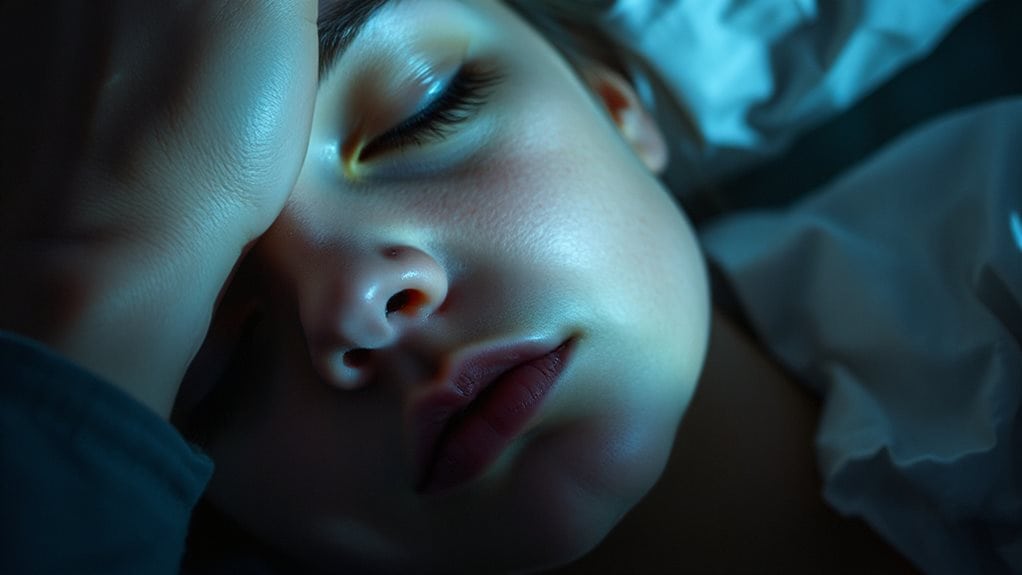
While your brain is busy constructing dreams during REM sleep, it’s not completely sealed off from the outside world—external stimuli can slip through and shape what you experience. In some cases, sensations that occur just before losing consciousness, like dizziness or tunnel vision from pre-faint symptoms, may also be woven into dream content as the brain tries to make sense of changing bodily signals.
Electrical muscle stimulation on your forearm may trigger arm movements in dreams, while haptic vibrations often become part of the dream environment.
Though vision and sound dominate dreams, touch, smell, and taste also appear, especially when daytime experiences prime your brain for sensory replay.
One study found that dream incorporation of physical sensations occurred most strongly with electrical muscle stimulation.
The Brain’s Role in Creating Vivid Lucid Dream Sensations
Your dreams don’t just happen—they’re built, moment by moment, by a precisely tuned network of brain activity. Acetylcholine enhances sensory and memory regions, while gamma waves sharpen awareness. Your prefrontal cortex reactivates, enabling control and clarity. Visual and parietal areas light up, crafting vivid, embodied sensations. Together, these systems turn dreams into experiences that feel undeniably real. High-quality sleep that preserves healthy REM sleep cycles further supports these brain processes, helping dreams feel more vivid and physically real.
Physical Sensations and Autonomic Responses During Lucid REM

Often, during lucid REM sleep, your body shows clear signs of heightened physiological activity, even as it remains immobilized. Your heart rate and breathing increase, and skin conductance rises, reflecting autonomic arousal. Despite paralysis, you exhibit increased REM density and distinct eye signals—like LRLR movements—to confirm lucidity. H-reflex suppression persists, maintaining spinal inhibition, while internal sensations may feel vividly real due to amplified brain activation. In some cases, this heightened activation overlaps with mixed awareness states, where elements of wakefulness and dreaming coexist and can intensify how real these sensations feel.
Tactile Illusions and Bodily Awareness in Dream States
Because your dreaming brain remains deeply engaged with bodily signals despite muscle atonia, tactile illusions can emerge with startling clarity during REM sleep.
You experience touch sensations as real, even when they’re illusions shaped by visual cortex and parietal lobe activity.
Sensory feedback from twitches or external stimuli gets woven into dreams, blending motion, pressure, and vision into a coherent, embodied experience.
In some cases, these vivid bodily sensations intertwine with emotional themes—such as feeling physically pushed, pulled, or submerged in a driving into water dream—mirroring how your mind encodes stress, overwhelm, and loss of control into fully embodied dream narratives.
Advancing Research Through Stimulation and Neural Connectivity
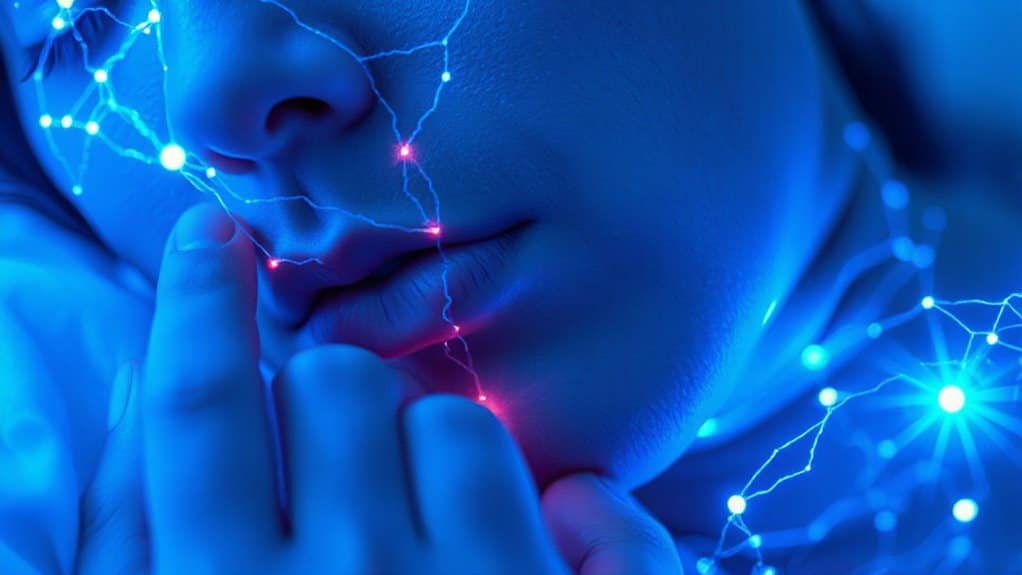
Unseal the hidden circuitry of dreaming, and you’ll find a fluid interaction of neural networks shaped by targeted stimulation and measurable connectivity.
You can use tACS or magnetic pulses to probe how brain rhythms influence dream content.
Sensory inputs during sleep alter dream emotion, while EEG reveals parieto-occipital shifts before N2 dreams.
In REM, vivid scenes emerge from limbic activation and cortical disconnection, patterns you can track and even modulate.
Techniques like MILD, systematic reality checks, and dream journaling demonstrate how intentional behavioral conditioning can bias neural activity toward lucid, thematically shaped dreams.
Wrapping Up
You experience dream sensations because your brain simulates touch, pain, and movement much like real life. During REM sleep, neural activity in sensory and motor regions creates convincing illusions of physical interaction. External stimuli can blend into dreams, shaping their content. Research using stimulation shows promise in decoding how connectivity between brain areas supports these vivid experiences, offering understanding into consciousness and perception without overcomplicating the mystery behind your remarkably real-feeling dreams.