

Time feels slower in your dreams because your brain’s internal clock misfires during REM sleep, stretching seconds into what seems like minutes. Motor inhibition makes movement feel delayed and effortful, while heightened emotional processing amplifies the sense of duration. Even though time perception warps, parts of your brain stay active, keeping basic timing intact. Your mind simulates experiences without real feedback, blending memory, emotion, and cognition—there’s more beneath the surface.
How Lucid Dreaming Reveals the Brain’s Internal Clock
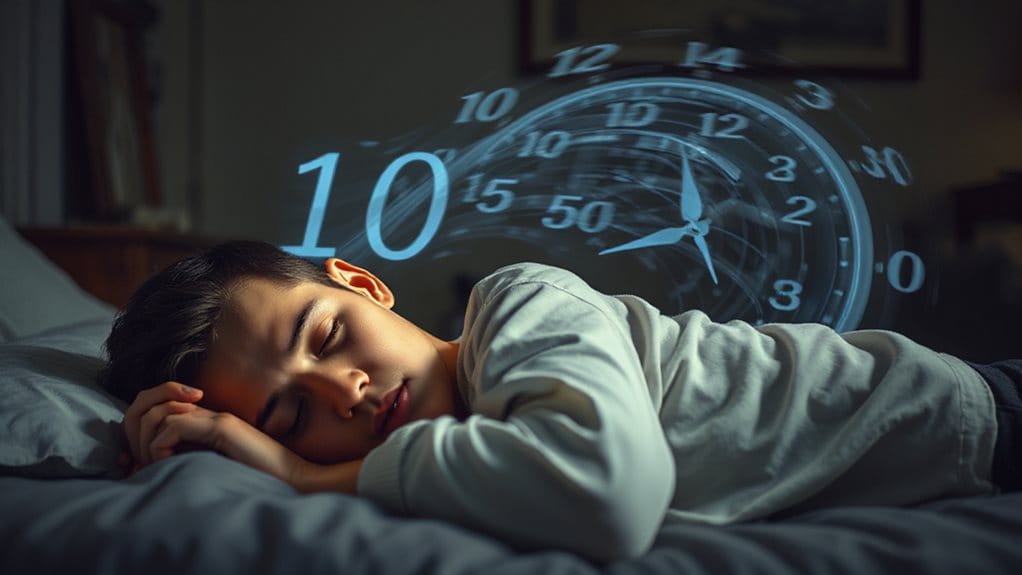
While your brain typically quiets down during sleep, certain regions spring back to life during lucid dreams, offering clues about how time perception is regulated in the sleeping mind. This mixed state of consciousness can sometimes blur the boundary between sleeping and waking, contributing to false awakenings where you briefly feel awake but are still dreaming.
You experience distorted time—simple tasks take longer—yet internal timing mechanisms remain somewhat intact, as seen in consistent counting. This suggests your brain’s clock still ticks, just slower, likely due to altered prefrontal and parietal activity shaping temporal awareness. Increased phasic activity during lucid REM sleep may contribute to this altered sense of time by enhancing dream intensity and cognitive processing.
Why Motor Tasks Feel Slower in the Dream World
You move through dreams as if wading through deep water—each step, jump, or turn unfolding with noticeable effort and delay. Motor tasks take longer because your brain simulates movement without real muscle feedback. In REM sleep, paralysis prevents physical action, forcing your mind to work harder. Neural processing slows, extending task duration by up to 52%, especially for walking or gymnastics—yet counting feels normal. This is partly due to REM paralysis and motor inhibition, which block normal proprioceptive feedback and make actions like punching or running feel strangely weak and slow.
The Neuroscience Behind Dream Time Distortion

Because your brain processes time differently during REM sleep, dreams often stretch moments beyond their real-world duration.
Your dopaminergic system alters internal clock speed—increasing it with dopamine agonists, slowing it with antagonists. This affects time perception, not sequence recognition.
Basal ganglia and frontal-mesolimbic circuits, driven by dopamine, shape dream time, making seconds feel like minutes through distorted temporal processing. During REM sleep, sleep quality and continuity also influence how clearly you experience and later recall these time-stretched dream episodes.
Emotional Intensity and the Expansion of Dream Duration
When emotionally charged events seep into your dreams, they don’t just appear—they linger, stretching the dream’s internal clock and making the experience feel longer than it really is. High emotional intensity increases how often events appear in dreams, especially threatening ones. Your brain processes these intensely, slowing perceived time. REM sleep, rich in emotion and theta activity, supports this time expansion, helping you process and regulate intense waking experiences efficiently. In some cases, your mind may even use intense imagery like torture dreams as a symbolic outlet, allowing unresolved stress and conflict to surface and be processed within this expanded sense of dream time.
Linking Dream Reports to Real Sleep Physiology

While dreams often feel like private, untethered experiences, they’re firmly rooted in measurable brain activity, and recent research has begun to map subjective dream reports onto concrete sleep physiology.
You show higher beta power in the occipital area during REM recall, indicating cortical arousal. In NREM, reduced low-frequency activity in parieto-occipital regions supports dream retrieval, revealing that dreaming relies on localized, wake-like activation even outside REM. These neural signatures may also help explain why emotionally intense dream voices—from calm guidance to chaotic or unsettling voices—track with distinct patterns of arousal and internal conflict during sleep.
Wrapping Up
You experience time differently in dreams because your brain’s internal clock runs irregularly during REM sleep. Neural activity slows for motor tasks, making actions feel prolonged, while emotional intensity stretches perceived duration. Lucid dreaming shows you can sometimes recognize these distortions, revealing how the brain constructs time. Dream reports align with sleep physiology, confirming that your mind isn’t just inventing moments—it’s reorganizing them. Time bends, but never breaks.