
You’re seeing the Neb‑Senu statue’s 180° turn as a prophetic dream because the motion aligns with ancient Egyptian ideas of Ka and Ba vessels, while modern data show hidden micro‑vibrations from visitor traffic that trigger stick‑slip friction on the glass shelf. The steatite’s magnetite content may also respond to ambient magnetic fields, adding a subtle pull. Together these factors create a dream‑like, almost mystical impression that hints at unseen forces, and the next sections will explain how to document and verify this phenomenon.
Why the Neb‑Senu Rotation Feels Like a Prophetic Dream?
Why does the Neb‑Senu rotation feel like a prophetic dream? You notice its slow, daytime‑only spin, a perfect circle that defies its decades‑long stillness, and you link that motion to the back inscription invoking Osiris for offerings. The statue’s sudden turn toward visitors mirrors ancient rituals, while engineers cite vibrations and friction. This blend of mystique and plausible physics creates a dream‑like, yet analytical, impression. Much like the eerie clarity of sleep paralysis, the statue’s motion blurs the line between rational explanation and a haunting sense of unseen forces at work. The movement is most likely caused by environmental vibrations from foot and vehicle traffic.
What the Neb‑Senu’s Spin Reveals About Hidden Micro‑Vibrations?
How does the Neb‑Senu’s spin illuminate the hidden micro‑vibrations that constantly batter the museum? You’ll see that a three‑axis sensor under the glass recorded peaks at 18:00 GMT and 07:00 GMT, matching traffic and footfall. The statue’s convex base amplifies those vibrations, causing anti‑clockwise jerks during busy daylight. Overnight, vibrations cease, so rotation stops, confirming that external traffic and visitor movement drive the micro‑vibrations. Just as subtle symbols in dreams can reveal hidden forces shaping our self‑worth, the Neb‑Senu’s spin exposes unseen vibrations that quietly influence the statue’s behavior.
Stick‑Slip Vibration Explains the 180° Spin
The Neb‑Senu’s spin, which peaks when foot traffic and daytime vibrations surge, can be traced to a classic stick‑slip mechanism that turns those tiny tremors into a full 180° rotation. You’ll notice the glass shelf’s slight tilt and hard, flat contact points let intermittent friction “stick” then “slip,” pivoting the convex base. Footsteps, trolleys, and trains supply sub‑0.1g vibrations that, over many tiny jerks, drive the statue’s smooth half‑turn, stopping when activity ceases. Much like dreams about falling trees are interpreted through subtle symbolic cues, the statue’s rotation emerges from small, easily overlooked physical triggers accumulating over time.
How Steatite’s Magnetite Might Be Pulling the Statue
You’ll notice that the steatite making up the statue contains measurable magnetite, which can become magnetized during firing or by lightning strikes.
Ancient artisans likely recognized this property and deliberately aligned the stone’s magnetic poles with surrounding lodestones or natural fields, creating a subtle pull that could move the figure over time.
When modern visitors bring rare‑earth magnets or when sunlight intensifies the stone’s magnetization, the resulting attraction can shift the statue’s position, supporting the old magnetic‑alignment theory. Studying this phenomenon is similar to how exploring hidden thoughts and feelings in dreams can uncover deeper beliefs and motivations behind what we perceive.
Magnetite Content in Steatite
Where does the hidden pull of the statue originate? You’ll find it in steatite’s magnetite, which makes up 12‑15 % of the rock by volume. Its saturation magnetization hovers near 95 J T⁻¹ kg⁻¹, close to pure magnetite. Iron resides mainly in magnetite (≈23 % of total iron) and hematite, while trace Al, Cr, Mg, Ni subtly modify its crystal lattice, enhancing magnetic stability.
Ancient Magnetic Alignment Theory
How could a statue seem to drift toward a hidden magnetic source? You’ll notice that steatite often contains magnetite, which aligns with Earth’s field when heated.
Ancient artisans, aware of lodestone behavior, could have positioned the stone so its magnetic pole matched a concealed magnet or lightning‑charged basalt base.
The resulting pull would gently shift the statue, explaining the observed movement without invoking supernatural forces.
Ancient Egyptian Beliefs About Statuettes as Soul Vessels
What drives the ancient Egyptian practice of placing statuettes in tombs? You see that Ka, the life force, needed a dwelling after death, so artisans crafted Ka statues to host it.
Ba, the mobile personality, could merge with that statue, creating a complete soul vessel.
Offerings sustained both, while the shadow and ren added protective layers, ensuring the deceased’s journey to the afterlife.
Just as emotional nudity in dreams symbolizes a fear of being seen too clearly, these soul vessels reflect a deep concern with how the true self is perceived, protected, and preserved beyond death.
Experiments to Test the Statue’s Rotation
The rotating statue, which fascinated scholars after the 180‑degree turn captured on time‑lapse video, now serves as the test case for a series of controlled experiments.
You isolate the piece from foot traffic, place it on a flat, non‑vibrating platform, and measure weight distribution on its base.
You also scan curvature, apply magnets, and record motion with high‑speed cameras to pinpoint causes.
Mythical Accounts of Moving Statues and Their Possible Links to the Neb‑Senu Rotation
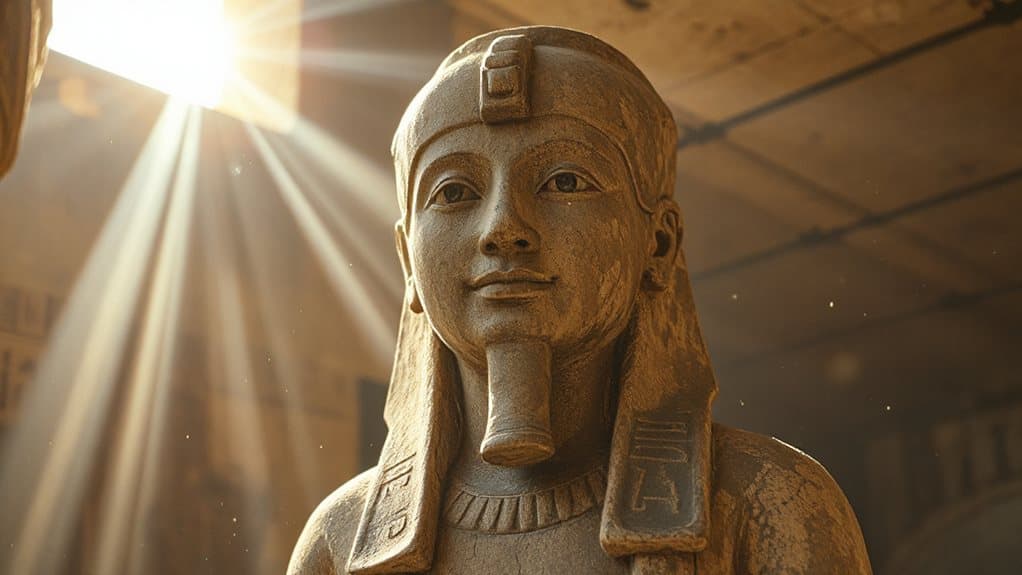
Ever since ancient texts first described statues that seemed to walk or turn, scholars have catalogued dozens of mythic accounts linking divine agency to moving stone figures. You’ll notice that many cultures describe wandering idols, often attributing motion to resident spirits or gods. In Egypt, the Neb‑Senu statue’s slow rotation echoes these legends, suggesting its *ka* might animate the stone, a notion reinforced by ritual offerings that supposedly trigger movement.
Psychological Meaning of Dreaming About the Neb‑Senu Rotation
Why does the Neb‑Senu’s slow spin appear in your dreams? You may be processing unresolved tension, as the statue’s gradual rotation symbolizes a lingering issue you can’t resolve. The ancient Egyptian context adds a layer of mystery, prompting your mind to explore hidden knowledge.
This dream pattern often signals a need for patience, urging you to examine underlying beliefs and slowly shift perspectives.
Tips for Documenting Unusual Museum Phenomena
You should set up high‑resolution video cameras that record continuously, then note the exact time each anomaly appears to the millisecond. By matching those timestamps with visitor traffic logs, you can see whether crowds, staff movements, or specific exhibit interactions precede the event. This correlation lets you separate random glitches from patterns that might indicate a causal relationship.
Capture High‑Resolution Video
How can you ensure that every subtle shift of an ancient statue is captured with the fidelity a museum exhibit demands? Set your camera to 3840 × 2160 UHD at 23.98 fps for standard filming, and switch to 60 fps if you need slow‑motion detail. Export in H.264 .mp4 for online sharing or ProRes 422 HQ .mov for archival masters, keeping resolution at 1080p or higher. Use 2.0 stereo audio and embed .srt captions for accessibility. Adjust luminance to 700 mV, chroma within vector limits, and black level to 0 mV to preserve signal integrity.
Log Precise Time Stamps
After recording the statue’s motion in high‑resolution video, the next step is to lock down exact timing data for any irregularities you observe.
Use a synchronized digital clock or NTP‑linked device, note start and end times to the second, and log each frame’s timestamp in a spreadsheet.
Correlate these marks with sensor readings, ambient conditions, and observer notes to create a precise, searchable record.
Correlate Visitor Traffic Patterns
What patterns emerge when you map visitor traffic against exhibit layout, and how can those patterns reveal unusual museum phenomena?
You visualize popular paths with thick lines, limit arrows to the top 50% of transitions, and overlay heatmaps from iBeacons.
Clustering volunteer vectors shows gender‑age clusters, while occupancy sensors flag bottlenecks.
Combining floor plans with flow data highlights dead zones and unexpected movement spikes.
When to Seek Expert Confirmation on the Rotation
When you notice the statue’s slow, daytime rotation, the first step is to decide whether the observed motion warrants professional verification.
You should consult an expert if the rotation exceeds a few degrees per hour, if it persists despite reduced foot traffic, or if sensor data shows unusual vibration patterns.
A physicist can confirm stick‑slip friction, while a conservator can assess structural stability.
Wrapping Up
You’ve seen how the Neb‑Senu’s 180° spin can be explained by stick‑slip vibration, magnetite‑rich steatite, and subtle micro‑vibrations that mimic ancient Egyptian ideas of statues as soul vessels. The phenomenon aligns with mythic accounts of moving statues, yet remains grounded in physics rather than prophecy. Documenting the event, noting environmental factors, and consulting experts will help separate genuine mechanical causes from speculative interpretation.

Seraphina Lumina is a dream interpretation and symbolism researcher with a passion for exploring the connections between dreams, emotions, relationships, spirituality, and personal growth. She draws on traditional dream symbolism, psychological perspectives, and spiritual traditions to help readers make sense of their night-time experiences and the themes that may appear in them.