

You’re not just seeing random scenes when you dream of places that don’t exist—your brain is actively building them. During REM sleep, the hippocampus and visual areas recombine memories into coherent, unfamiliar terrains. Prefrontal activity supports awareness, letting you investigate these worlds with surprising clarity. Sensory cues, intention, and even VR before bed can shape where your mind goes. Your dreams simulate reality so well that they feel real in the moment—and what happens there might reveal more than you think.
The Science Behind Lucid Dreaming and Spatial Hallucinations

While you might think lucid dreaming is a rare phenomenon, research shows it’s more common than you’d expect—over half of adults report having at least one in their lifetime, and about a quarter experience them monthly. Because lucid dreaming typically arises from REM sleep, factors like sleep quality and regular sleep cycles can influence how often you experience these vivid, controllable dreams.
Your brain shows increased prefrontal activity during these dreams, blending wake-like reasoning with REM sleep. This hybrid state may explain vivid, imaginary terrains you steer with awareness, as neural coherence spikes in frontal regions, supporting conscious control within dream environments.
One of the most effective ways to induce such dreams combines the MILD + WBTB technique, which has been shown to result in lucid dreams for 54% of participants within just one week.
How the Brain Constructs Unreal Landscapes During Sleep
When you drift into REM sleep, your brain doesn’t just replay memories—it actively builds them into new worlds. Your hippocampus and parahippocampal areas reactivate, blending spatial maps with sensory fragments. Weakly spatial cells and grid patterns recombine, guided by PGO waves and ripples. Dreaming isn’t random; it’s a structured simulation, constructing coherent, often impossible, scenes from the building blocks of past experience. In this process, your mind can generate convincing unfamiliar settings that feel like unknown places in dreams, often reflecting future-oriented concerns and subconscious attempts to guide your decisions.
Virtual Reality as a Gateway to Dreamed Environments
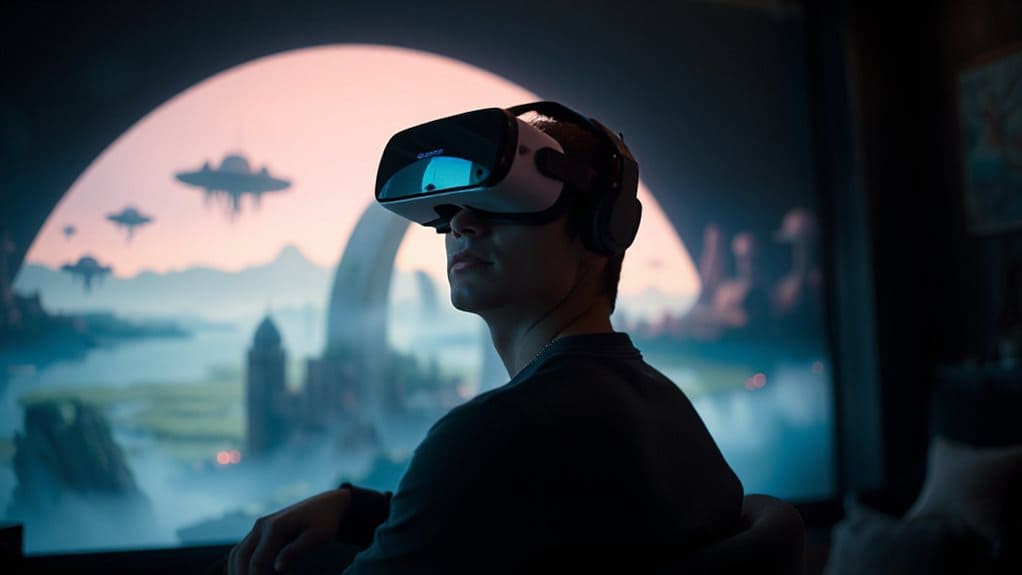
Your brain already builds unreal terrains every night, stitching together memories and sensations into dream worlds that feel real while you’re in them.
Now, virtual reality can shape those sceneries. By immersing you in awe-filled, surreal environments before sleep, VR primes your dreams—inducing lucid experiences, ego-dissolution, and even enhanced creativity, with effects lingering well into waking life. Using VR as a pre-sleep immersion tool can work together with techniques like reality checks and dream journaling to increase the likelihood of vivid, controllable dream environments.
Recreating Digital Worlds in the Realm of Dreams
From the moment you step into a digitally crafted world, the boundary between simulation and imagination begins to blur. You interact with environments that respond in real time, shaped by AI like Genie 3, which generates fluid scenes without rigid 3D models. These synthetic worlds mimic physical laws, support ecosystems, and enable exploration—all while feeling increasingly coherent and immersive, challenging what you consider real. As your awareness deepens in these simulated realms, subtle cues—like flickering lights or shifting patterns—may echo the spiritual notion of reality sending gentle signals of guidance and awakening.
Waking Imagination vs. Dream-State Creativity

Though you might think of imagination as a deliberate act of the waking mind, it actually operates continuously across both conscious and unconscious states, shaping your experience whether you’re steering the day or lost in dreams. You rely on sensory input while awake, but in dreams, memory and emotion fuel imaginative output. Both states feed creativity—just through different sources. In dreams, this ongoing imaginative process often surfaces as symbolic scenes and narratives that help you process emotions, and practices like dream journaling can make it easier to recognize recurring patterns and turn those insights into personal growth.
Neural Activation Patterns in Lucid Dreamers
Open the hidden structure of lucid dreaming, and you’ll find a brain that’s both familiar and strangely reconfigured.
You engage frontal regions for self-awareness, while the precuneus supports your sense of agency. Beta power drops, yet gamma surges in temporo-occipital zones. Your brain enhances alpha connectivity and strengthens frontoparietal networks, blending control with dream flexibility—clarity within chaos.
Techniques to Induce Dreams of Non-Existent Places

You can use dream incubation methods like MILD or VILD to shape your dreams toward imaginary places by setting clear intentions before sleep.
Trying sensory stimulation tricks, such as the SSILD technique’s focus cycles, helps sharpen awareness during the shift into dreaming.
If you’re open to new tools, VR-enhanced lucidity training might prep your brain to investigate made-up worlds more vividly.
Dream Incubation Methods
While your subconscious mind drifts through the night, it can be gently guided toward inventing entirely new environments if you actively shape your pre-sleep routine.
You can incubate dreams of non-existent places by repeating affirmations, visualizing vivid scenes, and placing symbolic objects nearby.
Journaling intentions and reviewing dreams each morning strengthens recall.
Combining these methods nightly enhances success, as studies show consistent practice leads to meaningful dream engagement.
VR-Enhanced Lucidity
Because virtual reality can simulate environments indistinguishable from dreamscapes, it’s become a powerful tool for shaping the content and clarity of your dreams. You experience dream-like VR scenarios that enhance lucid dreaming, especially when combined with reality checks and classic techniques.
Flying simulations, for example, increase lucid dream frequency and emotional intensity. Your brain incorporates VR elements—like those from *Ripple*—into dreams, enhancing control and awareness.
Sensory Stimulation Tricks
Virtual reality may train your mind to recognize dream states, but sensory stimulation offers a more direct nudge by feeding cues from the waking world into your sleeping brain.
You can use light, sound, or vibrations to signal you’re dreaming, helping you spot oddities.
Devices detect REM sleep and deliver cues, while tACS enhances gamma waves linked to lucidity.
Combining senses works better—multisensory input sharpens awareness, making imaginary places feel real.
Using Sensory Stimuli to Shape Dream Geography

Shaping the terrains of your dreams isn’t just left to chance—sensory stimuli can actively guide the geography that unfolds in your sleeping mind. Odors paired with environments often steer dream settings, especially rural ones, though scent rarely appears directly in reports.
Visual and vestibular cues influence bizarreness and body movement, while out-of-context sounds enhance lucidity. Multimodal methods show promise, but results vary widely due to differing approaches across studies.
Dream Incubation and the Power of Intention
Long before modern psychology put dreams under the microscope, people were quietly shaping their nighttime visions through focused intention—a practice known as dream incubation.
You plant a question or image in your mind before sleep, not to control dreams, but to guide them. By repeating a phrase like “I’m exploring a hidden valley,” you signal your subconscious.
This method, rooted in ancient traditions from Greece to Indigenous cultures, uses intention as a seed. When combined with journaling or sensory visualization, it increases the odds of dreaming about imagined terrains.
Science backs this: studies show pre-sleep focus increases dream incorporation. You’re not just waiting for understanding—you’re inviting it.
Exploring Sacred and Imagined Sites Through Lucid Dreams

You can investigate sacred sites in your lucid dreams just as easily as you might walk through them in waking life, using intention and dream signs to guide you.
Once lucid, you’re able to construct or enter imagined worlds that feel real, shaped by cultural symbols or personal vision.
These dream spaces aren’t just fantasy—they can deepen spiritual understanding or help test ideas about actual archaeological places.
Sacred Sites in Dreams
Sacredness often reveals itself not just in stone and soil, but in the mind’s quiet attunement to place.
You access sacred sites in dreams through lucid awareness, where intuition shapes testable revelations—like acoustic trances from pecked stones.
Tibetan, Sufi, and Native traditions have long used these dreams for spiritual wayfinding.
Your dream consciousness, active in REM, links memory, metacognition, and terrain in meaningful, groundbreaking ways.
Building Imagined Worlds
Dreams don’t just replay memories—they build worlds. You can summon environments from nothing, shaping them with intention and sensory detail.
By engaging sight, sound, and touch, you deepen immersion. Your brain treats these simulations like reality, allowing exploration guided by curiosity.
Use dream-signs or impossible elements to stay lucid. Over time, you co-create rather than control, letting the dream evolve naturally.
Breakthroughs in Two-Way Communication With Dreamers
Imagine this: you’re deep in REM sleep, your body still but your mind adrift in a dream world—then a voice cuts through, asking you to solve a math problem.
You hear it, understand, and respond with eye movements.
Scientists in four countries have done this, using sounds, lights, or mild shocks.
Dreamers answered questions, did math, even chatted with each other—proving two-way communication is possible.
Wrapping Up
You shape dreamscapes more than you realize, blending memory, intention, and sensory cues into coherent, unreal worlds. Lucid dreaming lets you steer these spaces consciously, while research shows external stimuli can influence their layout. Virtual environments prime your brain to recreate similar scenes in sleep. Though dreams feel spontaneous, techniques like incubation reveal a level of control. These findings don’t just explain odd nighttime exploits—they hint at deeper links between imagination, perception, and consciousness.

Seraphina Lumina is a dream interpretation and symbolism researcher with a passion for exploring the connections between dreams, emotions, relationships, spirituality, and personal growth. She draws on traditional dream symbolism, psychological perspectives, and spiritual traditions to help readers make sense of their night-time experiences and the themes that may appear in them.