
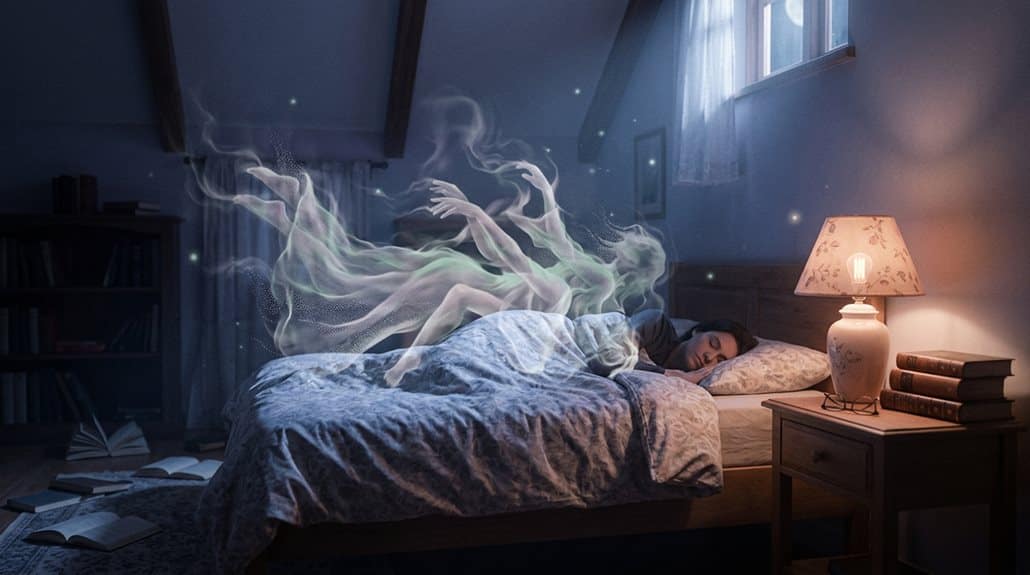
Humans dream to support essential brain functions like memory consolidation, emotional regulation, and problem-solving. During REM sleep, increased brain activity reorganizes emotional memories and clears unnecessary information, while the surreal nature of dreams results from specific neural processes and reduced external stimuli. Dreams can also promote creativity and help process subconscious conflicts. Understanding these functions explains why dreams are a universal and complex phenomenon—keep exploring to uncover more about how your mind operates overnight.
Why Do We Dream? The Main Theories Explained

Dreaming has long fascinated researchers because it appears to serve several important functions for the brain.
During REM sleep, neural activity increases, supporting memory consolidation and emotional regulation.
Dreaming may also act as mental housekeeping, clearing unnecessary information.
This process enhances cognitive functioning and problem-solving, helping you process experiences and strengthen neural pathways essential for learning and mental health.
In some cases, dreams about emotional overwhelm may reflect the brain’s effort to process stress, fear, or a sense of losing control.
How Dreams Help Us Remember and Process Emotions
Emotional processing during sleep plays a crucial role in how our brains manage feelings from the day, and dreams are central to this function. During REM sleep, dreams facilitate emotional regulation and memory consolidation by reorganizing emotional memories.
Dream analysis can reveal subconscious conflicts, helping us understand and process feelings, ultimately promoting healthier emotional responses and improved mood. Dreams can also act like a subconscious signal that highlights unresolved emotional wounds, encouraging us to reflect on what is causing stress or pain.
What Physiological Factors Influence How Often and Vividly We Dream

Various physiological factors influence how often and vividly you experience dreams, particularly during REM sleep. Increased brain activity, driven by neurotransmitters like acetylcholine and dopamine, enhances dream vividness.
Neural oscillations such as theta and gamma waves, along with brainstem activity, modulate dream intensity.
During REM, sensory input diminishes as the thalamus closes, allowing internal experiences to dominate. Sleep paralysis can occur when REM atonia spills into wakefulness, leaving consciousness aware while the body remains briefly immobile.
Why Are Some Dreams Surreal or Bizarre? The Brain’s Role in REM Sleep
The unique nature of surreal and bizarre dreams can be explained by the way the brain functions during REM sleep. Increased brain activity, driven by neurotransmitters like acetylcholine and dopamine, creates vivid imagery and hallucination-like scenarios.
The thalamus’s suppression reduces external stimuli, allowing dream content to become illogical, fantastical, and disconnected from reality.
Can Dreams Boost Creativity or Help Solve Problems?
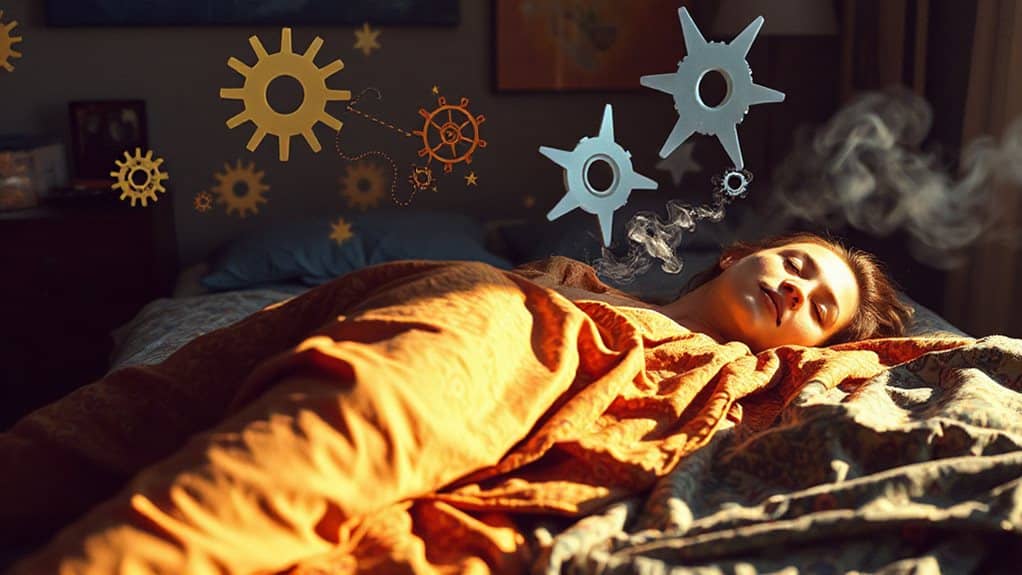
Dreams can serve as a powerful tool for creativity and problem-solving because they create a relaxed mental environment where the usual constraints of logic and practicality are loosened. During REM sleep, the subconscious investigates different solutions, facilitating memory processing and innovation.
Many ideas, from Mendeleev’s periodic table to song compositions, originate from dreaming, enhancing problem-solving skills. Woven symbols like a Tree of Life dream catcher are also used to represent continuity and inspiration, reflecting how dreams can support imaginative thinking.
Wrapping Up
In conclusion, dreams serve multiple functions, from processing emotions to potentially enhancing creativity. Theories suggest they help us consolidate memories, solve problems, or simply reflect brain activity during sleep. Physiological factors like stress, sleep stages, and brain chemistry influence dream vividness and frequency. While no single explanation fully accounts for why we dream, ongoing research continues to illuminate this complex aspect of human cognition, revealing that dreams remain a fascinating intersection of biology and psychology.

Seraphina Lumina is a dream interpretation and symbolism researcher with a passion for exploring the connections between dreams, emotions, relationships, spirituality, and personal growth. She draws on traditional dream symbolism, psychological perspectives, and spiritual traditions to help readers make sense of their night-time experiences and the themes that may appear in them.